

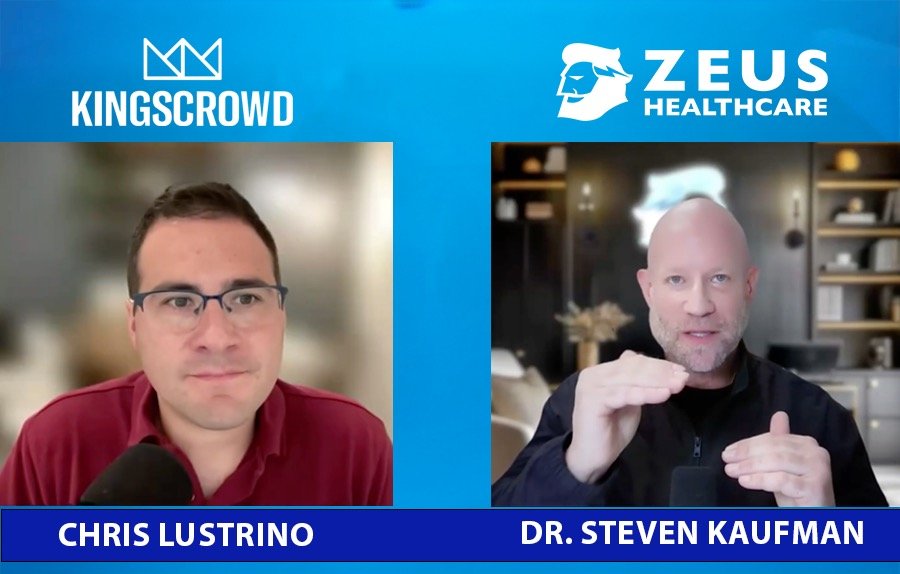
Dr. Steven Kaufman, founder of Zeus Companies, appeared on a KingsCrowd-hosted investor education webinar to discuss healthcare real estate as a distinct commercial asset class. The conversation, moderated by KingsCrowd CEO Chris Lustrino, covered the structural characteristics that Kaufman says make medical tenants the most defensible in commercial real estate, the results of a recently completed seven-year development project, and how Zeus Companies evaluates physician partnerships.
KingsCrowd is a private market research and ratings platform that hosts a recurring series of sponsored educational webinars for accredited investors. The Zeus Companies episode, titled “Healthcare Real Estate Investing,” aired live on July 21, 2025, and is available for replay on the KingsCrowd platform.
A FRAMEWORK FOR EVALUATING COMMERCIAL HEALTHCARE TENANTS
During the webinar, Kaufman outlined six criteria he said Zeus Companies uses to evaluate the quality of a commercial real estate tenant, a framework he described as the product of 25 years of healthcare investing across more than $7 billion in transactions. He presented the criteria not as proprietary to Zeus but as a general-purpose evaluation tool for any investor considering commercial real estate with a medical component.
The six criteria Kaufman described are:
- Triple net lease structure, in which the tenant bears all operating expenses including insurance, janitorial, and utilities
- Meaningful tenant improvement investment by the tenant, not only the landlord, creating financial commitment to the space
- Long-term lease duration, typically 7 to 15 years, with Kaufman noting one current Zeus tenant is under lease through 2044
- Pre-leased status before construction begins, removing reliance on speculative lease-up
- A financially established tenant rather than a first-year or early-stage operator
- Tenant co-investment in the real estate itself, aligning the tenant’s financial interests with those of the landlord
- Kaufman argued that healthcare tenants are uniquely positioned to satisfy all six criteria simultaneously, and contrasted that with other commercial categories where one or more criteria are typically absent. He cited dentists as the most extreme example of tenant stickiness, noting that the physical infrastructure required to operate a dental practice makes relocation a significant financial undertaking for the tenant.
During the conversation, Dr. Kaufman explained, “A dentist cannot just relocate. The reason dentists are considered the most sticky commercial tenant of any type in the United States is that they cannot just move all of those sinks, all of that power, all of those chairs. They need the real estate to actually conduct their business.”
EXIT RESULTS: HOUSTON MEDTAIL DEVELOPMENT CLOSES WITHIN $12,000 OF 2018 PRO FORMA
Kaufman disclosed the final results of a recently completed equity investment: a 30,000-square-foot medtail development in Houston’s Heights neighborhood that Zeus Companies underwrote in 2018 and exited in mid-2025. The project combined a freestanding emergency room with an anchored retail development and was held for approximately seven years.
According to Kaufman, the exit price came within $12,000 of the original pro forma projection on a $14 million transaction, a variance he characterized as less than one-tenth of one percent. He also reported that the project’s net operating income exceeded the revenue projection in the original pro forma by 37%. The investment had five partners, and Kaufman stated that each investor realized a profit of $1 million or more at exit.
Kaufman attributed the result to what he described as a dual-layer underwriting process: Zeus evaluates every potential equity investment first as a lender, asking whether the firm would originate a loan against the asset before considering it as an equity opportunity. He noted that the emergency room component of the project was sold separately in 2023 to a third-party operator, and that the retail real estate was held until the current exit.
Dr. Kaufman stated, “We underwrote it in 2018. We had not even heard of COVID. We exited about a month ago. We missed the pro forma exit price by $12,000 on a $14 million transaction, seven years later. And we underestimated revenue by 37%.”
PHYSICIAN PARTNERSHIP MODEL: HOW ZEUS STRUCTURES HEALTHCARE EQUITY DEALS
Kaufman described Zeus Companies’ approach to healthcare equity as centered on physician partnership rather than conventional landlord-tenant relationships. He said that in every equity investment the firm has made except one currently in progress, all co-investors have been physicians. No outside financial investors have participated in those deals.
He explained that Zeus typically seeks a minority ownership interest in the operating healthcare company in addition to the real estate, a structure he said is uncommon because most healthcare operators do not open their capital tables to outside investors. When such access is granted, Kaufman said, it has historically been the most profitable component of Zeus’s investments, consistently outperforming the real estate returns.
On the question of whether physicians make capable business partners, Kaufman pushed back on the conventional skepticism. “In my experience, most of those physicians know how to raise their hand and ask for help when they absolutely need it. Who’s smarter: the person who thinks they’re the smartest, or the person who recognizes they’re not the smartest and they need help?”
ASSET CLASSES ZEUS AVOIDS: OPERATOR-DEPENDENT INVESTMENTS WITHOUT KNOWN OPERATORS
Kaufman used the webinar to articulate an explicit prohibition in the firm’s investment thesis: Zeus does not invest in assets that are heavily operator-dependent unless the firm has an intimate, established relationship with the operator. He named biotech facilities, AI-dependent tenants, and co-working spaces as categories the firm declines on this basis.
He noted that vacated biotech and specialty build-outs can present secondary acquisition opportunities, since those tenants tend to over-invest in tenant improvements before departing, leaving behind high-quality, purpose-built space that a healthcare tenant can occupy at a fraction of the original build cost.
HOUSTON MARKET COMMENTARY
Kaufman repeated and expanded on commentary from a prior KingsCrowd appearance regarding Houston’s economic positioning. He cited the Houston Ship Channel’s post-COVID status as the leading U.S. port by import and export volume, surpassing the combined output of the Los Angeles, New Orleans, and New York ports, and reiterated population projections showing Houston adding more residents by 2030 than currently live in Austin.
He described second-generation healthcare space in Houston as among the most sought-after commercial real estate in the city, noting that previously built-out medical suites lease faster and at stronger rates than comparable new construction because prospective tenants avoid the time and cost of a full build-out.
To learn more about Zeus Companies visit: https://zeuscompanies.com
About Zeus Companies
Founded over 20 years ago, Zeus Companies is a private equity firm with platforms spanning debt, equity, and healthcare investments. Under the leadership of Managing Principal Dr. Steven Kaufman, the company specializes in real estate-backed credit with a focus on the Texas market. Dr. Kaufman holds advanced degrees in economics, psychology, and organizational leadership and is a frequent media contributor on Bloomberg, CNBC, and Fox Business. Zeus Companies maintains a track record of over 17,000 loan transactions totaling more than $7 billion in real estate volume while delivering monthly distributions to investors for two decades.
About KingsCrowd
KingsCrowd provides institutional-grade research and analytics tools for alternative investing, with a focus on private equity and private debt deals. The platform offers educational programming and resources to help investors identify and evaluate investment opportunities across alternative asset classes.
Spotlight News

Spotlighting global leaders and trendsetters in Business, Finance, Real Estate, Legal, Health, Lifestyle and Technology.